Storage Ideas for a Bedroom With No Closet: Build a Closet Without Building One
No closet in your bedroom? Create practical storage for hanging clothes, folded clothing, shoes, accessories, and seasonal items without filling the room with bulky furniture.
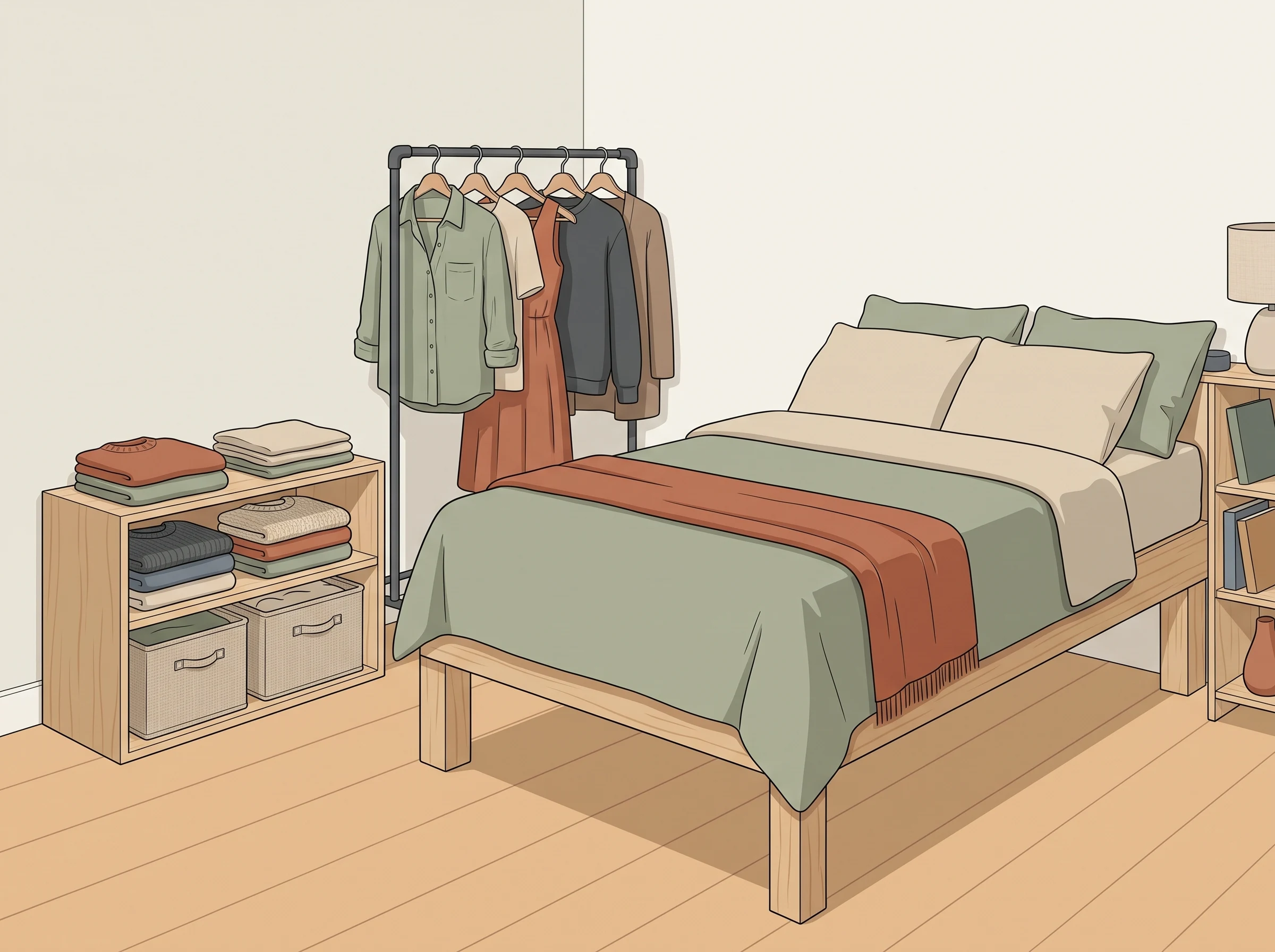
A bedroom without a closet does not necessarily have a storage problem. It has a storage-system problem.
A traditional closet quietly performs several different jobs:
- hanging clothes,
- storing folded clothes,
- keeping shoes together,
- organizing accessories,
- hiding less attractive items, and
- holding seasonal clothing.
When the closet disappears, trying to replace all of those functions with one enormous wardrobe can consume a large portion of a small bedroom.
A better approach is to rebuild the closet function by function. That may mean using a clothing rack for hanging garments, drawers for folded clothes, under-bed containers for seasonal items, and a few closed boxes to control visual clutter.
Here is how to build that system.
1. Decide what your missing closet needs to hold
Before buying a wardrobe or clothing rack, sort your belongings into storage functions. Use five basic groups.
Hanging
Examples include dresses, jackets, button-down shirts, trousers, and clothing that wrinkles easily.
Folded
Examples include T-shirts, sweaters, workout clothes, and sleepwear.
Shoes
Consider how many pairs actually need to stay in the bedroom.
Accessories
Examples include belts, bags, scarves, jewelry, and hats.
Seasonal or low-frequency items
Examples include winter clothing, spare bedding, luggage, and rarely used bags.
The point is to avoid building a full-size imitation closet when only part of your wardrobe actually needs hanging space.
2. Create a small hanging zone
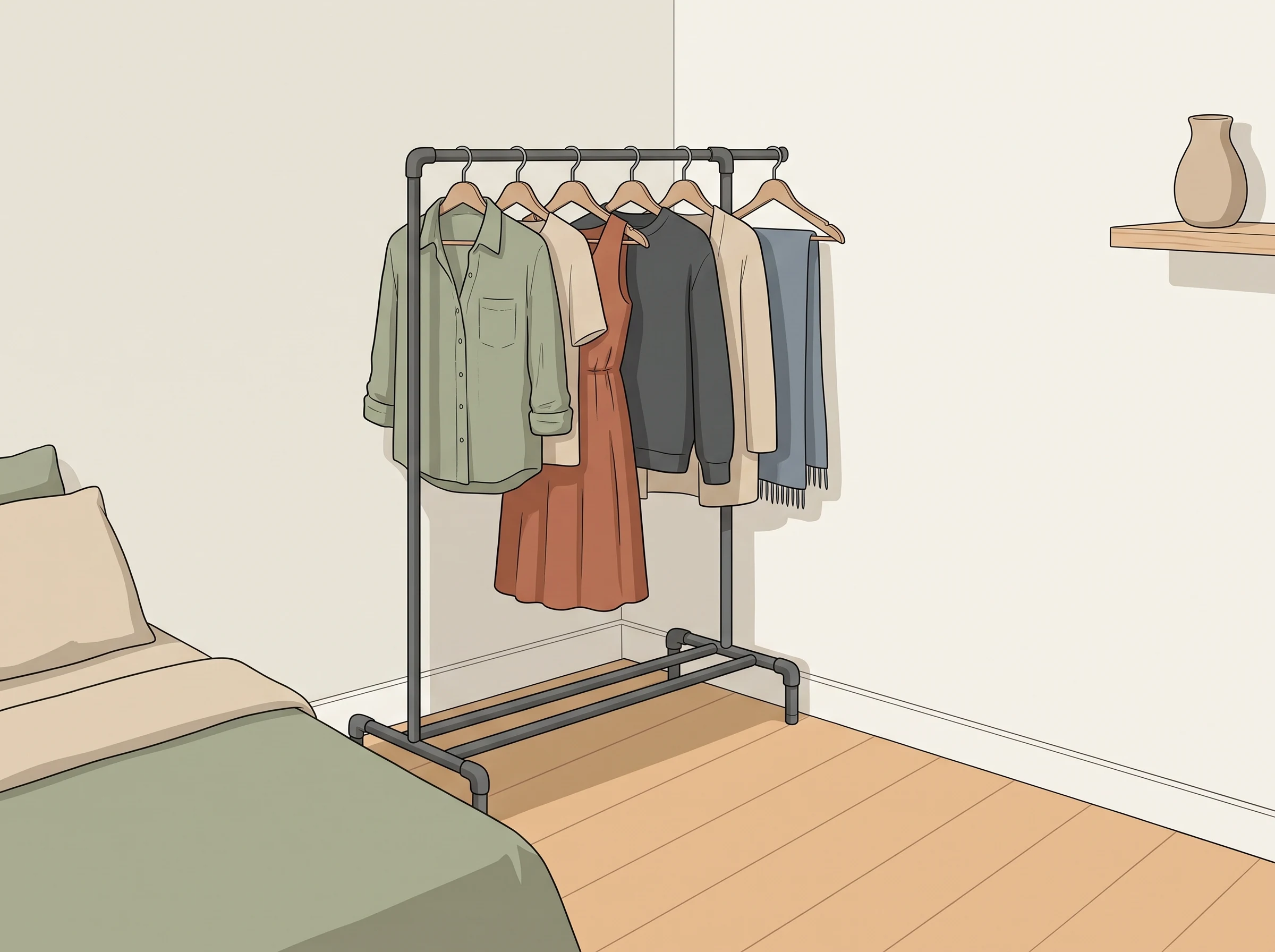
If you need hanging space, a freestanding garment rack is one of the simplest substitutes for a closet rod.
A compact rack can work well for:
- work clothes,
- frequently worn outfits,
- jackets,
- dresses, and
- clothing you want to keep wrinkle-free.
Do not hang everything
One mistake is trying to put your entire wardrobe onto the rack. An overloaded rack becomes visually heavy and can make the room feel more cluttered than it actually is.
Instead, use the rack for a defined category: current-season hanging clothes only. Fold other items elsewhere.
What to look for
Consider overall width, depth, height, manufacturer-stated weight capacity, a lower shelf or shoe storage, wheels if mobility matters, and stability.
Best for
People who have a relatively small hanging wardrobe.
Tradeoff
Open clothing becomes part of the room’s visual environment. If seeing your entire wardrobe feels chaotic, combine the rack with more closed storage elsewhere.
3. Give folded clothes their own storage
A hanging rack does not replace drawers. T-shirts, underwear, sweaters, workout clothes, and sleepwear often work better folded.
Possible solutions include:
- compact drawer units,
- a small dresser,
- drawer storage built into other furniture,
- shelf-and-bin systems, and
- under-bed drawers.
The key is to avoid buying a huge dresser by default. Estimate how much folded clothing you actually have first. If three compact drawers are enough, a six- or eight-drawer piece may consume floor area without solving an additional problem.
Organize drawers by category
A simple system might be:
- Drawer 1: underwear and socks
- Drawer 2: T-shirts
- Drawer 3: workout and sleepwear
Defined categories are easier to maintain than a general-purpose clothing drawer.
Best for
Clothing that does not need hanging and items you prefer to keep visually concealed.
Tradeoff
Deep drawers can become difficult to use if clothing is simply stacked from bottom to top. Keep categories narrow enough that items remain accessible.
4. Turn one wall into the closet zone
Scattering clothing storage around every wall can make a small bedroom feel like a storage room. Instead, consider concentrating most clothing storage along one wall or one defined zone.
A closet wall might combine:
Upper shelf or boxes
        ↓
Hanging clothes
        ↓
Small drawers / baskets
        ↓
Shoes
This recreates much of the vertical organization of a traditional closet.
Why zoning helps
The room now has two visual functions: a storage zone and a sleeping/living zone, rather than having clothes everywhere.
Best for
Rooms with one relatively uninterrupted wall.
Tradeoff
Measure carefully before committing an entire wall. Make sure drawers, doors, and nearby furniture still have room to operate.
5. Use a curtain to hide an open wardrobe
Open wardrobes are efficient, but not everyone wants to look at clothing while trying to relax.
One solution is to place storage along a wall or inside a nook and visually separate it with a curtain. The storage behind the curtain might include a clothing rack, shelving, drawers, shoe storage, or baskets.
Why a curtain can work
It provides some of the visual benefit of a closet door without requiring a conventional swinging door. It can also make mismatched storage components look like one intentional system.
For renters
Check how the curtain rod or track is installed. Options differ depending on wall construction, ceiling construction, lease restrictions, and manufacturer requirements. Do not assume that a tension rod or adhesive installation is appropriate for every situation.
Best for
People who like inexpensive modular storage but dislike seeing it all the time.
Tradeoff
Leave enough clearance between the curtain and storage so clothing and drawers remain easy to access.
6. Use under-bed space as your seasonal closet
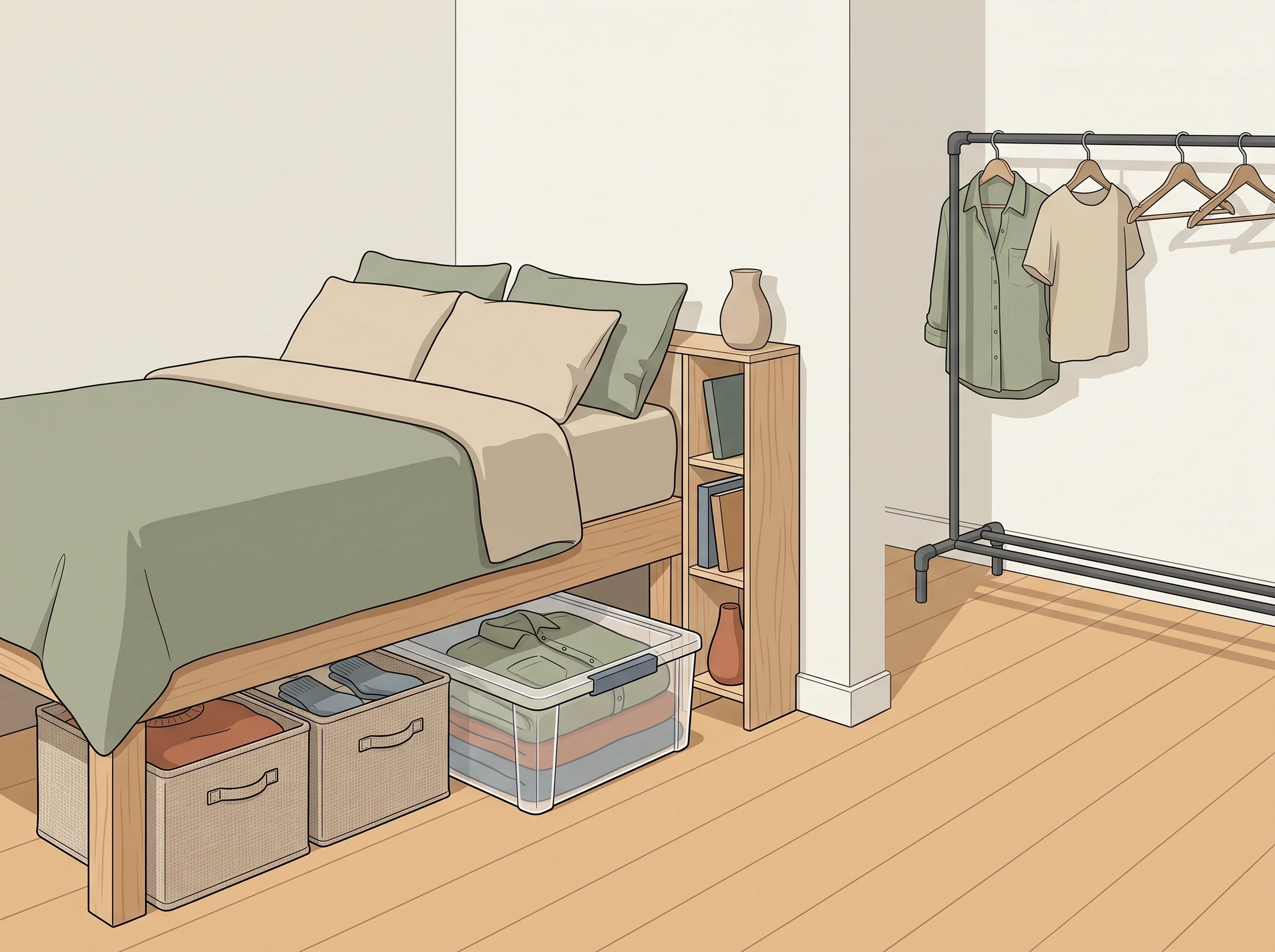
The items you use least frequently should not occupy the most convenient storage. Seasonal clothing, spare linens, and occasional accessories are good candidates for under-bed storage.
Possible categories include:
- winter sweaters,
- coats during warmer months,
- spare blankets,
- seasonal shoes, and
- extra bags.
Measure first
Record vertical clearance, width, usable length, any center supports, and the clearance needed to slide containers out. Choose containers after measuring, not before.
Best for
Low-frequency and seasonal belongings.
Tradeoff
Do not put your everyday wardrobe under the bed unless access is exceptionally easy.
7. Separate shoe storage from clothing storage
Shoes can consume a disproportionate amount of a small clothing-storage system. Instead of automatically giving every pair bedroom space, decide which shoes actually belong there.
Consider keeping frequently worn shoes near the entryway, seasonal or special shoes in the bedroom, and rarely used shoes in longer-term storage.
Within the bedroom, possible approaches include low shoe shelves, lower garment-rack shelves, under-bed shoe containers, vertical shoe storage, and compact cubbies if their dimensions fit your collection.
Best for
Preventing shoes from consuming valuable hanging and drawer capacity.
Tradeoff
Avoid buying highly specialized shoe storage until you know how many pairs need to live in the bedroom.
8. Use the door for lightweight accessories
The bedroom door can provide useful secondary storage. Over-the-door systems can work for scarves, belts, small bags, hats, accessories, and lightweight clothing.
Check the door before buying
Measure door thickness, clearance above the door, distance to adjacent wall or furniture, and organizer depth. Make sure the door can still open and close properly.
Best for
Lightweight items you reach for regularly.
Tradeoff
Do not turn the entire door into a dense wall of miscellaneous belongings. Assign it a limited category.
9. Use upper shelves for low-frequency storage
When there is no closet shelf, you can sometimes recreate that function elsewhere in the room. High shelving can hold storage boxes, seasonal items, bags, and rarely used accessories.
Keep daily items lower
The higher the storage, the less convenient it becomes. Use accessible zones for daily needs and high zones for occasional needs.
Safety consideration
Wall-mounted shelves must be installed according to their instructions and appropriate to the wall construction and intended load. Renters should verify what installation is allowed under their lease rather than improvising unsafe mounting methods.
10. Consider a freestanding wardrobe only when you need one
Sometimes the simplest answer really is a wardrobe or armoire. A freestanding wardrobe may make sense when you have substantial hanging clothing, prefer closed storage, have enough wall width and floor depth, and want one consolidated storage unit.
But treat it as one option rather than the automatic answer.
Measure the full footprint
Do not measure only width. Check:
- Width: Will it fit the wall?
- Depth: How far will it project into the room?
- Door clearance: Can doors open without hitting the bed?
- Drawer clearance: Can drawers extend fully?
- Walkway: How much passage remains after installation?
A unit that technically fits against the wall may still make the room difficult to use.
11. Use modular storage when you expect to move
Renters often have another constraint homeowners do not: the next bedroom may be completely different. A storage system optimized for one exact wall may not fit the next apartment.
Modular components can be easier to adapt. Examples include:
- separate rack and drawers,
- stacking bins,
- adjustable shelving systems,
- small drawer units, and
- movable carts.
Best for
Renters who expect to move or who do not know how long they will stay.
Tradeoff
Too many independent pieces can create visual clutter. Keep finishes, dimensions, or containers reasonably coordinated.
12. Do not forget a laundry system
Without a closet, clothing tends to remain visible during every stage of use:
clean
↓
worn once
↓
dirty
↓
laundry
↓
clean again
If there is nowhere for the middle stages to go, clothing often ends up on a chair, the bed, the floor, or the garment rack.
Create an intentional place for laundry and, if needed, “wear again” clothing. Options include a compact hamper, divided hamper, designated hooks, or a small section of the clothing rack.
Open storage vs. closed storage
A closet normally hides clothing behind a door. Without one, you need to decide how much you are comfortable displaying.
Open storage
Examples include a garment rack, open shelves, and hooks.
Advantages: easy access, easy visibility, and often a relatively compact footprint.
Limitations: visual clutter, dust exposure, and a greater need for regular tidying.
Closed storage
Examples include drawers, a wardrobe, boxes, a storage bench, and containers behind a curtain.
Advantages: a calmer visual appearance, hidden irregular items, and clearer categories.
Limitations: more furniture volume, less-visible contents, and sometimes a larger floor footprint.
The best system is usually a hybrid
For many no-closet bedrooms, the most practical arrangement is not one giant wardrobe. It is something closer to:
SMALL GARMENT RACK
for hanging clothes

+

COMPACT DRAWERS
for folded clothing

+

UNDER-BED STORAGE
for seasonal items

+

DOOR / HOOK STORAGE
for accessories

+

CLOSED BOXES
for visual clutter
Each component solves a different part of the missing-closet problem.
Example: build a closet along a 6-foot wall
Suppose you have one available wall. Instead of filling it with a bulky wardrobe, you might divide it functionally:
LEFT
Narrow garment rack

CENTER
Compact drawer unit

RIGHT
Accessory hooks / shoe storage

ABOVE
Occasional storage if safely supported
This is only a planning example. Actual dimensions depend on the room and the specific products selected. Measure every component before purchasing.
What to measure before creating a closet zone
| Measurement | Why it matters |
|---|---|
| Available wall width | Determines total storage footprint |
| Maximum furniture depth | Protects walking space |
| Ceiling height | Determines usable vertical space |
| Bed-to-storage clearance | Maintains circulation |
| Door swing | Prevents collisions |
| Drawer extension | Allows drawers to open |
| Window location | Prevents blocking light/access |
| Baseboard depth | Can reduce usable wall clearance |
| Outlet location | Avoids inaccessible electrical outlets |
Use painter’s tape on the floor if necessary to visualize the proposed footprint before buying furniture.
Safety: be careful with tall clothing storage
No closet should not lead to unsafe improvised storage. For any wardrobe, dresser, shelving unit, or other tall storage product:
- follow the manufacturer’s instructions,
- use required stability or anchoring hardware,
- do not assume a piece is safe simply because it is freestanding,
- check current safety notices and recalls when appropriate, and
- work with your landlord if required installation conflicts with lease rules.
Renter-friendly storage should still be safe storage.
Choose the storage by function
| What you need to store | Start with |
|---|---|
| Dresses and jackets | Garment rack or wardrobe |
| T-shirts and underwear | Drawers |
| Sweaters | Drawers or shelves |
| Seasonal clothing | Under-bed storage |
| Shoes | Dedicated low or vertical shoe storage |
| Bags and scarves | Door, hooks, or accessory storage |
| Small accessories | Boxes or drawer organizers |
| Entire wardrobe out of sight | Closed wardrobe or curtained storage zone |
| Mixed wardrobe in a tiny room | Modular hybrid system |
A practical order of operations
If you are setting up a bedroom with no closet from scratch, try this order:
Step 1 — Edit the wardrobe
Do not build storage for clothing you no longer need.
Step 2 — Count what must hang
This determines whether you need a small rack or larger wardrobe.
Step 3 — Estimate folded storage
Determine the number of drawers or shelves actually required.
Step 4 — Move seasonal items out of prime storage
Use under-bed or higher storage.
Step 5 — Assign shoes and accessories
Keep them from taking over clothing storage.
Step 6 — Choose one primary storage zone
Concentrate the system where possible.
Step 7 — Measure the complete footprint
Include circulation and drawer or door opening space.
Step 8 — Buy only the missing pieces
Do not purchase an entire closet system until you know which functions still lack storage.
What not to do
Do not buy the biggest wardrobe that fits the wall
Depth and circulation matter just as much as width.
Do not put every piece of clothing on an open rack
Visual clutter can quickly overwhelm a small room.
Do not buy organizers before sorting
You may end up organizing things you should have removed.
Do not use every empty wall
A bedroom still needs visual breathing room.
Do not ignore safety instructions
Especially for tall furniture and wall-mounted systems.
Do not assume renter-friendly means zero attachment
Some storage products may require anchoring for safe use.
The bottom line
A missing closet does not need to be replaced by one large piece of furniture.
Instead, ask what the closet would have done:
- What needs to hang?
- What needs drawers?
- What can go under the bed?
- What needs to stay hidden?
- What do I use only seasonally?
Then create the smallest storage solution for each function.
For many bedrooms, a compact clothing rack, a modest drawer unit, under-bed containers, and a small amount of accessory storage can replace much of what a conventional closet would have provided—without turning the bedroom into a wall of furniture.
Product categories to compare next
Once you have measured the room, useful categories to compare include compact garment racks, freestanding wardrobes, small drawer units, under-bed clothing storage, shoe organizers, accessory organizers, closed storage boxes, and modular closet systems.
Choose products according to dimensions, storage function, stability, installation requirements, and how much usable floor area remains—not simply by total advertised storage capacity.
Relevant options
Product considerations
These are practical product types to evaluate against your measurements and installation limits.
Freestanding garment rack
Freestanding garment rack
May work well for:Comparing options for no closet space
- Useful when
- No closet space
- Consider
- Confirm load capacity footprint and any included anti-tip hardware
Potential benefits
- Relevant product category
- Retailer destination available
Covered clothes rack
Covered clothes rack
May work well for:Comparing options for no closet space
- Useful when
- No closet space
- Consider
- Confirm cover dimensions and ventilation needs
Potential benefits
- Relevant product category
- Retailer destination available
Hanging closet organizer
Hanging closet organizer
May work well for:Comparing options for no closet space
- Useful when
- No closet space
- Consider
- Confirm compatible rod type and weight limit
Potential benefits
- Relevant product category
- Retailer destination available
Seasonal under-bed storage bag
Seasonal under-bed storage bag
May work well for:Comparing options for no closet space
- Useful when
- No closet space
- Consider
- Confirm bed-frame clearance and intended soft-goods use
Potential benefits
- Relevant product category
- Retailer destination available