Small Bedroom Storage Ideas for Renters: 8 Ways to Make More Space
Make a small rental bedroom work harder with practical under-bed, over-door, vertical, and narrow storage ideas—without turning the room into a storage unit.
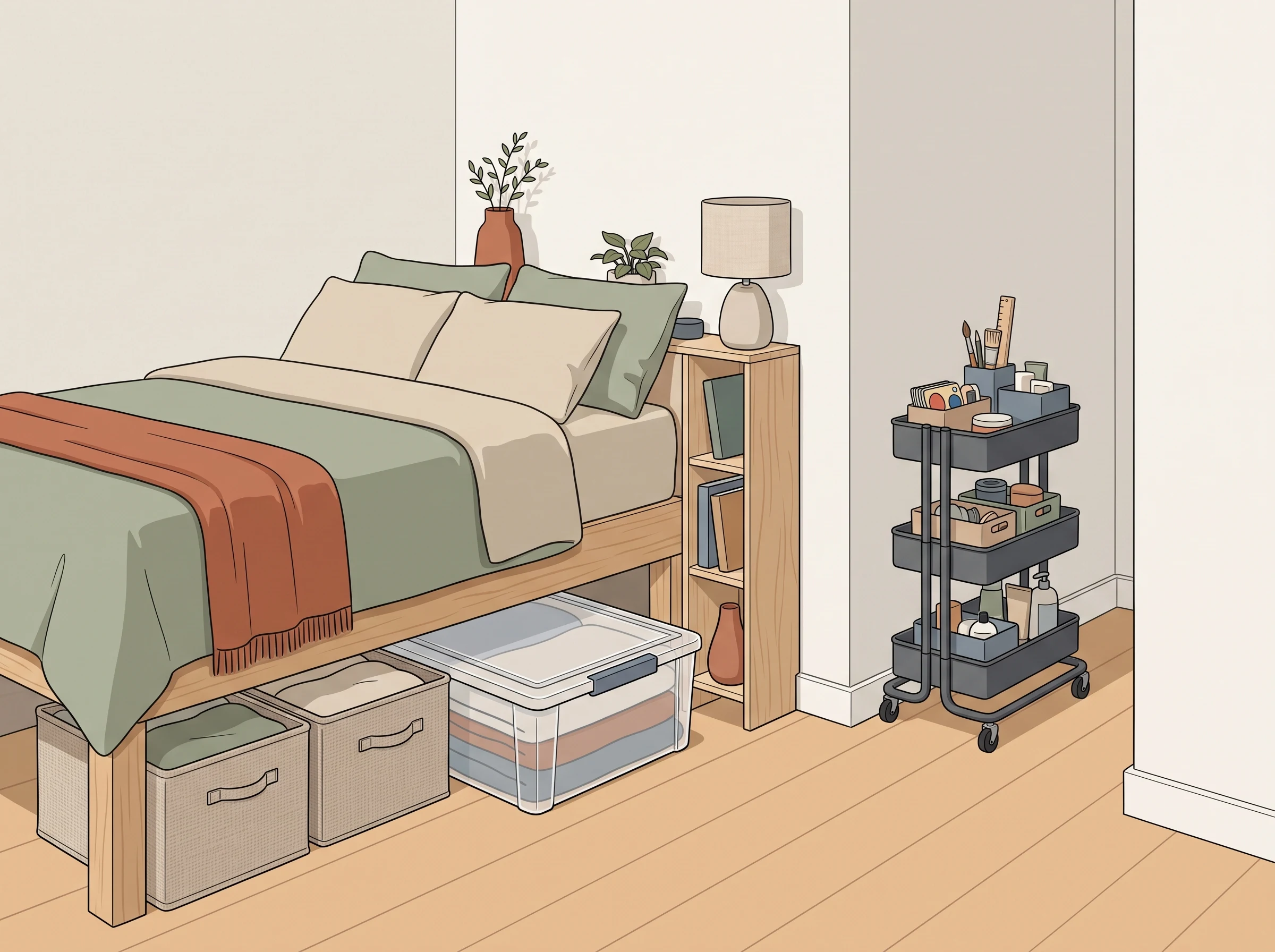
A small bedroom usually does not need more furniture. It needs the space you already have to work harder.
For renters, that can be more complicated. Built-in cabinetry may not be an option, drilling may be limited by your lease, and large furniture can make an already tight room harder to move through.
A better approach is to look for unused volume: the space under the bed, behind a door, above existing furniture, beside the bed, and inside furniture you already need.
Here are eight practical ways to find that space.
1. Start under the bed
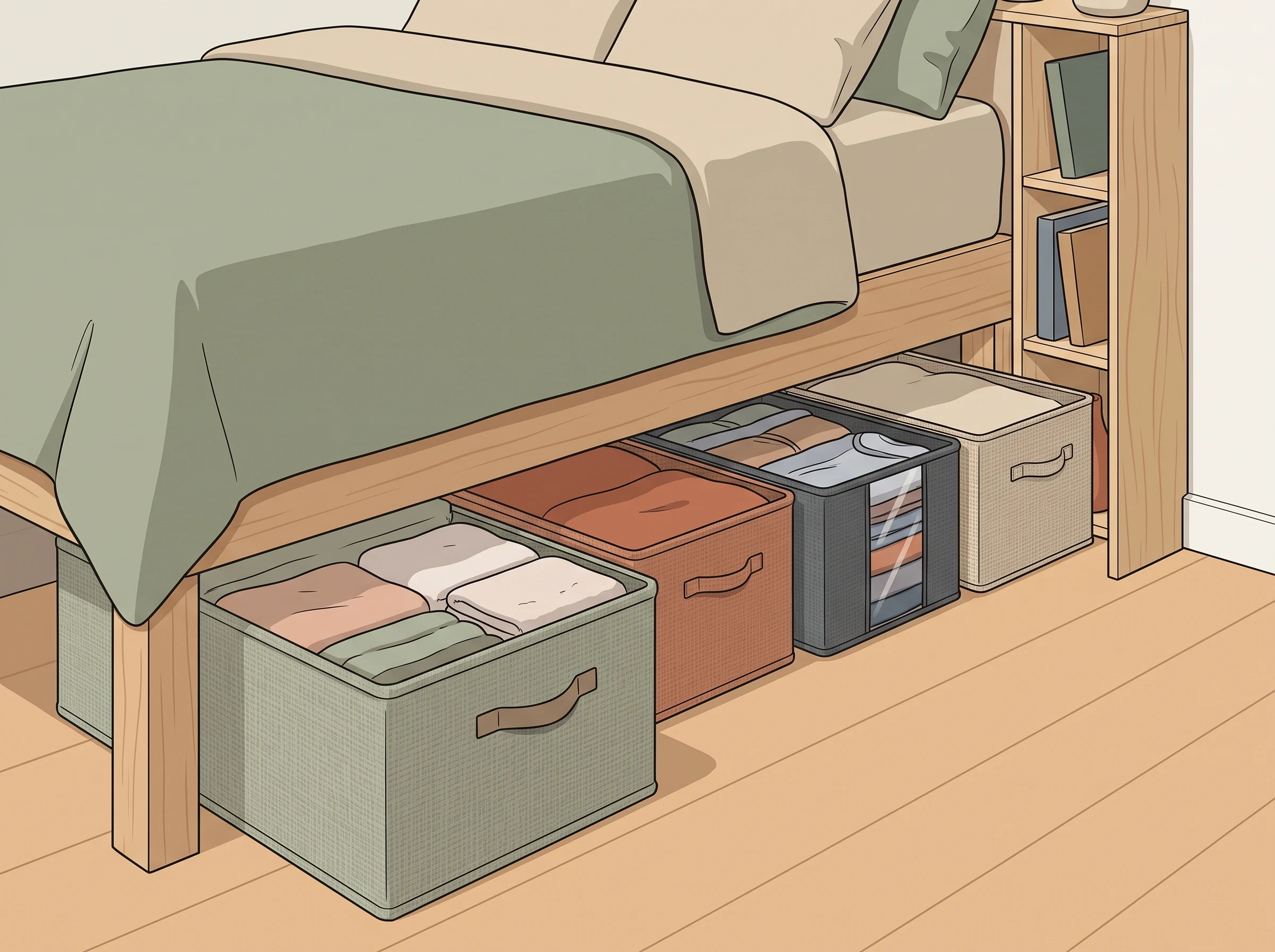
Before adding another cabinet or dresser, look under the largest object already in the room: the bed.
Under-bed storage is especially useful for things you need occasionally rather than several times a day, such as:
- extra bedding,
- seasonal clothing,
- shoes,
- bags, and
- spare towels.
What to look for
Measure the actual vertical clearance between the floor and the lowest part of the bed frame before buying containers.
A storage box that technically fits under the bed but catches on the frame every time you pull it out is not a good storage solution.
Useful features can include:
- low-profile construction,
- wheels or easy-pull handles,
- lids or zippered covers for less frequently used items, and
- transparent panels or labels.
Best for
Bulky items that would otherwise occupy valuable closet or dresser space.
Tradeoff
Under-bed storage is less convenient for things you use every morning. Reserve the easiest-access areas of the room for everyday items.
2. Use the back of the door
The bedroom door is easy to overlook because it already has a job. But its back surface can provide storage without consuming additional floor area.
Over-the-door organizers add vertical storage while keeping the floor clear. Depending on the organizer, this space can hold:
- bags,
- scarves,
- hats,
- shoes,
- accessories,
- sleepwear, and
- frequently worn clothing.
What to look for
Check three measurements:
Door thickness — hooks need to fit over the door.
Clearance above the door — the hook must not prevent the door from closing.
Organizer depth — deep baskets can collide with a wall or furniture when the door opens.
Soft-backed organizers can also help reduce rattling and surface contact.
Best for
Frequently used lightweight items that tend to end up on chairs or the floor.
Tradeoff
A heavily loaded organizer can make a door awkward to use, so more storage is not always better storage.
3. Replace a wide nightstand with narrow bedside storage
In a small bedroom, a conventional nightstand can occupy surprisingly valuable floor space.
Ask what you actually need beside the bed. For many people, the list is short:
- phone,
- glasses,
- water,
- book,
- charger, and
- small lamp.
You may not need a full two- or three-drawer nightstand to hold those items.
Consider instead:
- a narrow bedside table,
- a small rolling cart,
- a bedside caddy attached to the bed frame,
- a compact open shelf, or
- a shallow storage unit.
The goal is not to eliminate bedside storage. It is to match its depth and capacity to what actually needs to live there.
Measure this first
Pay particular attention to depth. A piece of furniture can look narrow from the front while still projecting far enough into the room to obstruct a walkway.
Best for
Bedrooms where the gap between the bed and wall is limited.
Tradeoff
Reducing furniture depth usually also reduces drawer volume. Store only true bedside essentials here and move bulk storage elsewhere.
4. Go vertical—but do it safely
When floor area is limited, height becomes useful. Vertical storage can take several forms:
- shelving,
- tall storage units,
- stacked containers,
- over-door organizers, and
- pegboards or hanging systems where permitted.
For renters, however, “no-drill” should not become a blanket rule.
Some tall furniture and clothing-storage units are designed to be secured according to manufacturer instructions. Furniture tip-over is a real safety hazard, particularly in homes with children. If a product requires wall anchoring, check your lease or ask your landlord rather than skipping an important safety step.
Best for
Books, folded clothing, accessories, baskets, and other items that would otherwise spread horizontally across the room.
Tradeoff
The highest shelves are best for less frequently used items. Everyday storage should stay within comfortable reach.
5. Look for the narrow gaps
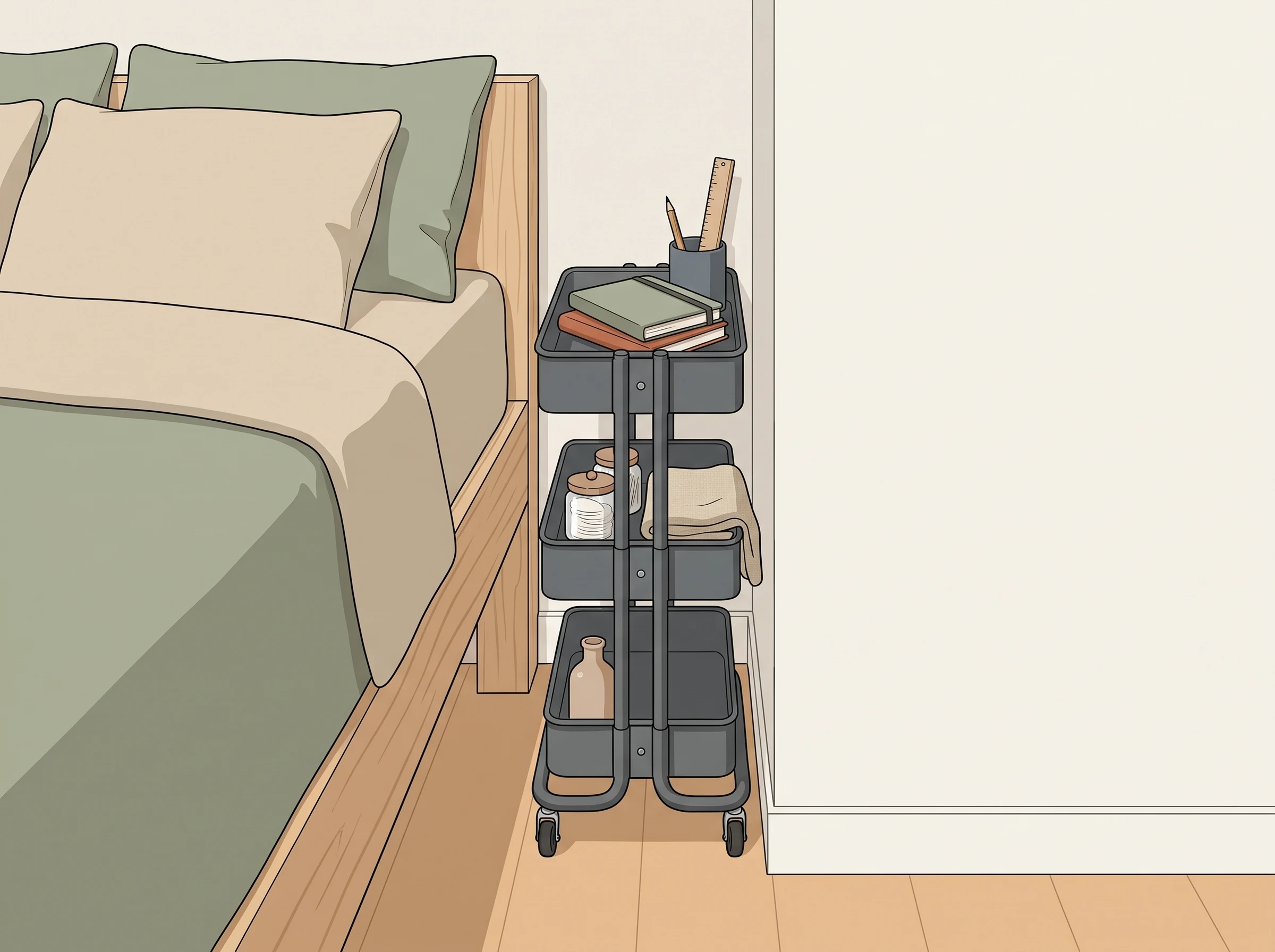
Small bedrooms often contain awkward strips of unused floor space:
- between the bed and wall,
- beside a dresser,
- near a desk,
- between furniture and a closet, or
- below a window.
A six- or eight-inch gap may be useless for conventional furniture but useful for intentionally narrow storage.
Possible solutions include:
- slim rolling carts,
- narrow drawer units,
- vertical baskets, and
- shallow book or accessory storage.
The key is to measure the gap before shopping, including baseboards and trim. Do not assume a nominal room dimension represents the usable width at floor level.
Best for
Small objects that need categories of their own: chargers, beauty items, notebooks, accessories, hobby supplies, or folded textiles.
Tradeoff
Very narrow storage is easy to overfill. Use it for a defined category rather than miscellaneous clutter.
6. Make one piece of furniture do two jobs
A small bedroom becomes difficult when every need gets its own piece of furniture.
Instead of a bed, bench, and storage chest, you may be able to use a bed and storage bench. Instead of a nightstand and shelving, you may be able to use bedside shelving with a usable top surface.
Other useful combinations include:
- bed frames with drawers,
- storage ottomans,
- benches with storage,
- headboards with shelves,
- desks with vertical storage, and
- rolling carts that can move between functions.
Best for
Rooms where circulation space matters more than maximizing raw storage volume.
Tradeoff
Multifunctional furniture is only helpful when you actually use both functions. Do not buy a bulky storage piece if the compartment is awkward to access.
7. Improve the closet before adding another dresser
If the bedroom already has a closet, improve what is happening inside it before automatically adding more furniture to the room.
Look for underused zones:
- floor area beneath hanging clothes,
- upper shelf space,
- unused door surface, and
- vertical space between short hanging garments and the floor.
Possible improvements include shelf dividers, stackable containers, hanging organizers, secondary clothing rods where compatible, compact drawer units, and coordinated bins.
Start by sorting
Before buying organizers, divide the contents into broad groups:
- hanging clothes,
- folded clothes,
- shoes,
- accessories,
- bedding, and
- seasonal items.
Then solve the storage problem for each category. This is more reliable than buying organizers first and trying to figure out what to put in them later.
Best for
Bedrooms where clutter is caused more by poor closet organization than by an actual shortage of storage volume.
Tradeoff
More organizers can make a closet worse if they simply subdivide clutter. Declutter first, then organize what remains.
8. Keep some storage closed
Open shelves are useful, but storing everything in plain sight can make a small room feel busier.
A practical bedroom usually benefits from a mix of open storage for things you use often and closed storage for things you need but do not need to see.
Closed storage can include:
- drawers,
- lidded boxes,
- baskets,
- zippered under-bed cases,
- cabinets, and
- fabric containers.
Best for
Clothing, spare bedding, cables, paperwork, and other visually irregular items.
Tradeoff
Do not hide frequently used items so thoroughly that retrieving them becomes inconvenient.
A better order for organizing a small bedroom
If you are not sure where to begin, work through the room in this order.
1. Remove what does not belong
Do not buy storage for things you no longer need.
2. Use existing hidden space
Start with under the bed, inside the closet, and behind the door.
3. Improve vertical storage
Use height before adding more wide furniture.
4. Fill genuinely useful narrow gaps
Measure first.
5. Replace oversized single-purpose furniture
Look for shallower or multifunctional alternatives.
6. Add storage only for a defined category
Every new organizer should answer: What exactly will live here? If there is no clear answer, you may be adding another place for clutter to accumulate.
What to measure before buying bedroom storage
A tape measure is one of the most useful small-space storage tools.
| Space | Measure |
|---|---|
| Under bed | width, length, vertical clearance |
| Bedside gap | usable width and maximum depth |
| Behind door | door thickness, wall clearance, organizer depth |
| Closet | shelf width/depth, hanging clearance, floor space |
| Narrow gaps | width at several heights |
| Walkways | remaining passage after furniture is installed |
Remember to account for baseboards, handles, hinges, electrical outlets, heating vents, and doors or drawers that need room to open.
A product that fits the measurement but prevents another part of the room from functioning does not really fit.
Which storage idea should you try first?
| Your problem | Start here |
|---|---|
| Not enough clothing storage | Under-bed storage and closet organization |
| Bags and accessories everywhere | Over-the-door organizer |
| No room for a full nightstand | Narrow bedside storage |
| Floor already crowded | Vertical storage |
| Awkward unused gap | Slim cart or narrow organizer |
| Too much furniture | Multifunctional furniture |
| Closet feels full but inefficient | Reorganize the closet |
| Room looks visually cluttered | Add more closed storage |
A note for renters
“Renter-friendly” does not automatically mean “damage-free” or “no installation.” Lease rules, wall materials, doors, paint finishes, and product instructions differ.
Before using screws, anchors, adhesives, tension-mounted systems, or wall-mounted storage, check your lease and the product instructions.
For furniture that requires anti-tip anchoring, do not omit the safety hardware simply to avoid making a wall attachment. Follow the manufacturer’s safety instructions and work with your landlord if permission is needed.
The bottom line
The best small-bedroom storage plan usually does not begin by buying another large piece of furniture.
Start by finding space the room is already giving you: under the bed, behind the door, above existing storage, inside the closet, and in narrow unused gaps.
Then match each storage solution to a specific category of belongings. That approach helps you create more usable storage without sacrificing the floor space that makes a small bedroom comfortable in the first place.
Next: choose the right storage for your room
We are building practical guides to the most useful small-space storage formats, including under-bed storage, slim rolling carts, over-the-door organizers, narrow bedside storage, and renter-friendly closet organization.
Measure your space first, then compare solutions by dimensions, access, installation requirements, and the specific problem they solve.
Relevant options
Product considerations
These are practical product types to evaluate against your measurements and installation limits.
Low-profile under-bed bin
Low-profile under-bed bin
May work well for:Comparing options for no closet space
- Useful when
- No closet space
- Consider
- Confirm bed-frame clearance and whether wheels roll on the intended floor
Potential benefits
- Relevant product category
- Retailer destination available
Over-door organizer
Over-door organizer
May work well for:Comparing options for no closet space
- Useful when
- No closet space
- Consider
- Confirm door thickness top clearance and door closing clearance
Potential benefits
- Relevant product category
- Retailer destination available
Narrow bedside caddy or table
Narrow bedside caddy or table
May work well for:Comparing options for no closet space
- Useful when
- No closet space
- Consider
- Confirm depth leaves a safe walkway
Potential benefits
- Relevant product category
- Retailer destination available
Slim rolling cart
Slim rolling cart
May work well for:Comparing options for no closet space
- Useful when
- No closet space
- Consider
- Confirm actual gap width and rolling path
Potential benefits
- Relevant product category
- Retailer destination available